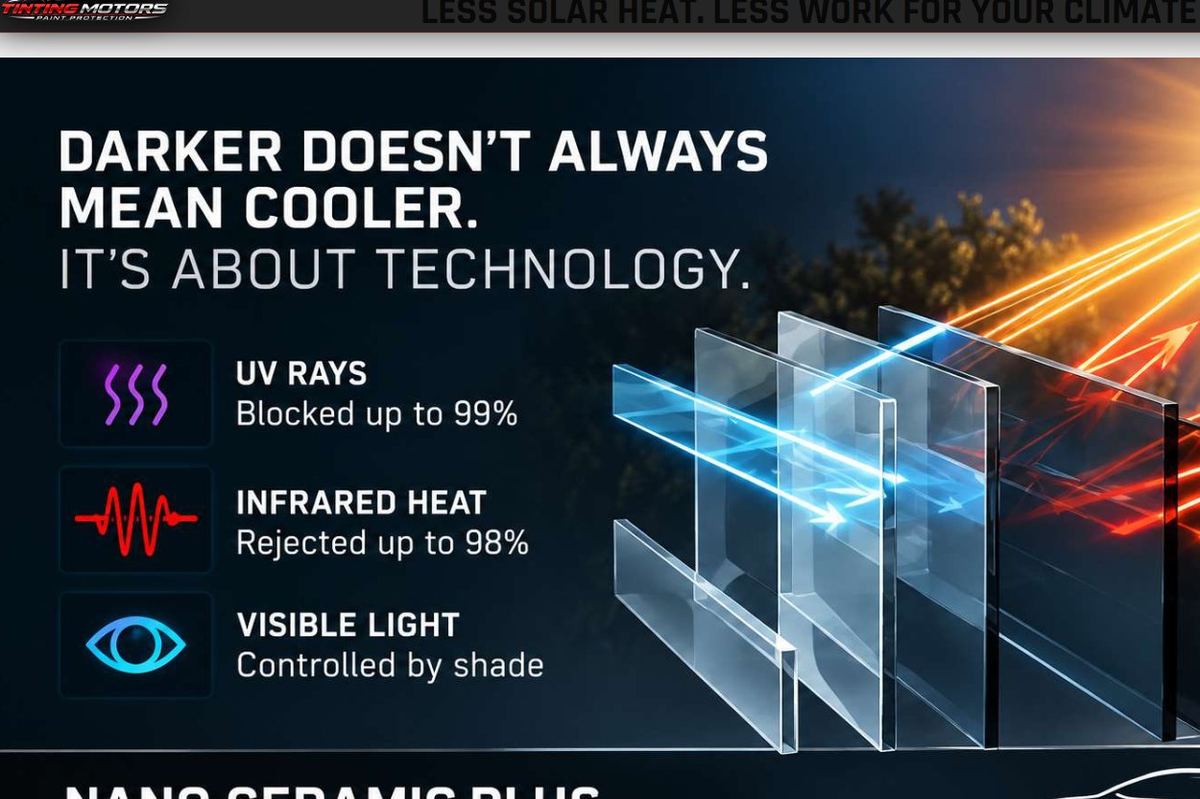
Darker doesn't always mean cooler. UV rays blocked up to 99%, infrared heat rejected up to 98%, visible light controlled by the shade you pick. Heat rejection comes from the film technology, not from how dark it looks.
VLT is Visible Light Transmission — the percentage of light the film lets through. The lower the number, the darker the film. Here's what each shade looks like, and what each film costs.
Four films, same installation standard, different levels of heat rejection. Coverage prices exclude the front windshield, roof glass and removal unless listed separately.
Every price here is a starting price before sales tax. The final price depends on the vehicle size and its condition, so we confirm the exact scope with you before booking.
Front glass is where New York's rules bite, so we measure the combined glass-and-film transmission before cutting anything.
Full tint and rear-half packages come in 5%, 15%, 20%, 35%, 50% and 70%. Windshield film comes in 35%, 50% and 70%.
Lets in very little light and looks almost black. Maximum privacy. Rear glass only in New York.
Very dark and still clearly a tinted car, with slightly more visibility than limo at night.
The most common rear-glass choice. Dark, clean, and you can still reverse comfortably after dark.
Noticeably tinted without being aggressive. A popular middle ground.
Light. Mostly bought for heat rejection rather than for the look.
Lets most light through and is barely noticeable — which is exactly why it's the option for front side windows in New York.
This is the single most common misunderstanding about tint, and it costs people money. How dark a film looks has very little to do with how much heat it stops.
A 70% ceramic film blocks far more heat than a 5% dyed film. If what you actually want is a cooler car rather than a darker one, the film technology is what matters — not the shade number.
The quote builder walks you through coverage, film type and shade with live pricing, then lets you book a bay and hold it with a deposit.
Everything is installed indoors in a climate-controlled bay at our Farmingdale facility.